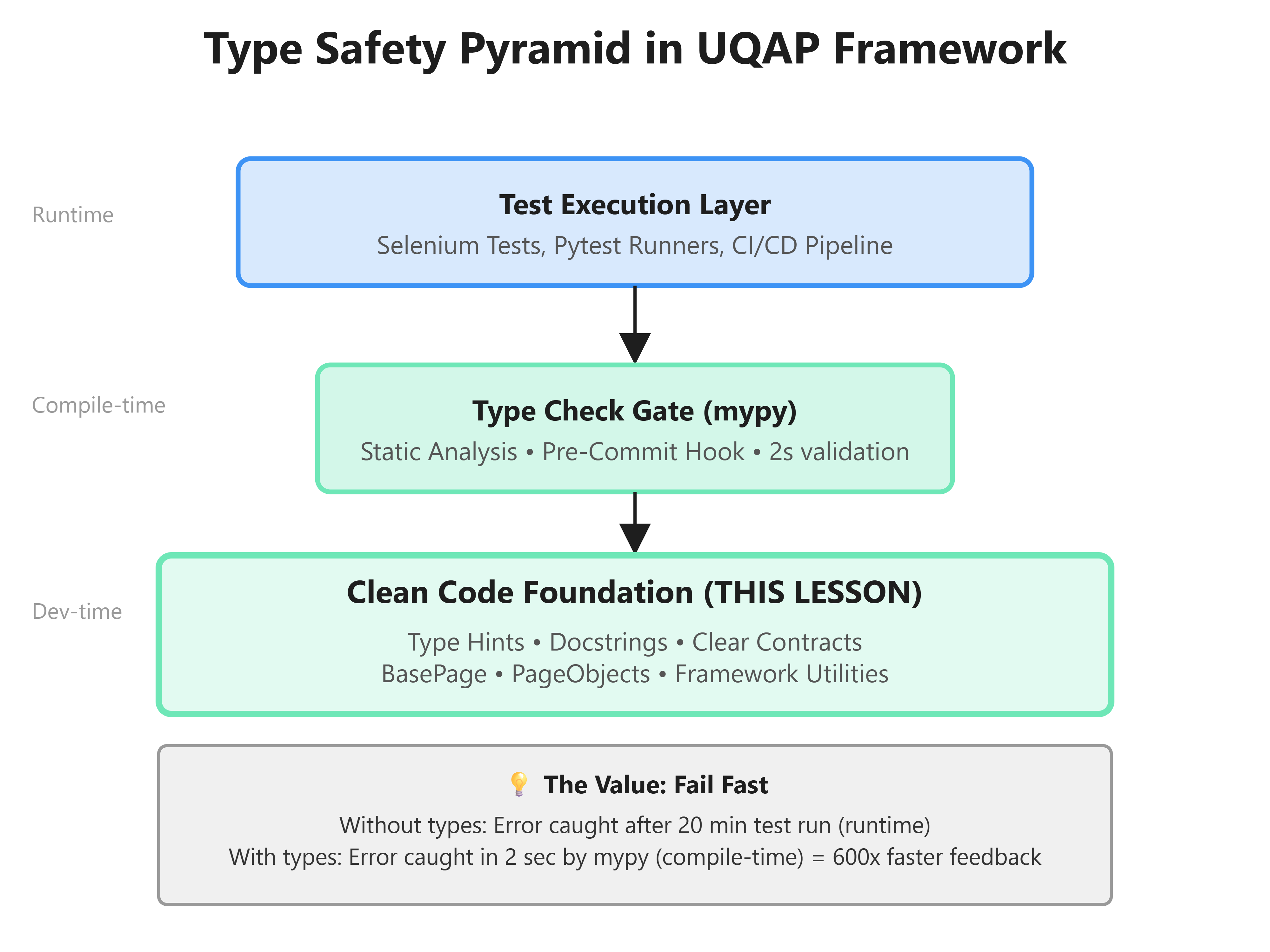
Lesson 30: Framework Review - The Type Safety Contract

The Junior Trap: “Python Doesn’t Need Types”
When manual testers transition to automation, they often write code like this:
class BasePage:
    def find_element(self, locator):
        return self.driver.find_element(locator)

    def click(self, locator):
        element = self.find_element(locator)
        element.click()
This looks clean. It works on their machine. But in a CI/CD pipeline running 500 tests across 3 environments, this code is a ticking time bomb.
Why? Because there’s no contract. A teammate calls
click((By.ID, "submit"))- works fine. Another callsclick("submit")- crashes at runtime. A third passesNoneaccidentally - fails silently until the test times out 2 minutes later.The scalability killer: In production test infrastructure, every ambiguous method signature costs your team 15-20 minutes of debugging time when something breaks. Multiply that by 50 developers over 6 months, and you’ve lost thousands of engineering hours to preventable errors.
The Failure Mode: The 3 AM Production Incident
Here’s what actually happens in production:
Scenario: Your CI/CD pipeline runs 800 Selenium tests nightly. Test #347 fails with:
AttributeError: 'NoneType' object has no attribute 'click'
The junior on-call engineer now has to:
Find which of 50 page objects has the bug
Trace through 200 lines of untyped code to see what returned
NoneDiscover someone passed a wrong parameter type 3 method calls earlier
Wait 25 minutes for the full test suite to re-run to verify the fix
The root cause: No type hints meant the error wasn’t caught in 2 seconds by a pre-commit hook. Instead, it cost 45 minutes of human debugging at 3 AM plus 25 minutes of CI/CD compute time.
The business impact:
Delayed deployment by 4 hours
$200 in wasted CI/CD compute credits
1 burnt-out engineer who quits next month
This is not hypothetical. This happens at every company that treats test automation as “just scripts.”
The UQAP Solution: The Type Safety Pyramid