Lesson 49 : GraphQL API Testing: Why status_code == 200 Will Lie to Your Face

The Junior Trap
Here’s how a manual tester-turned-coder writes their first GraphQL test:
python
import requests

response = requests.post(
    "https://countries.trevorblades.com/",
    json={"query": "{ country(code: \"US\") { name capital } }"}
)

assert response.status_code == 200
print("Test passed!")
This looks reasonable. It even runs green. Ship it, right?
Wrong. This code has a fatal flaw that will haunt you in production.
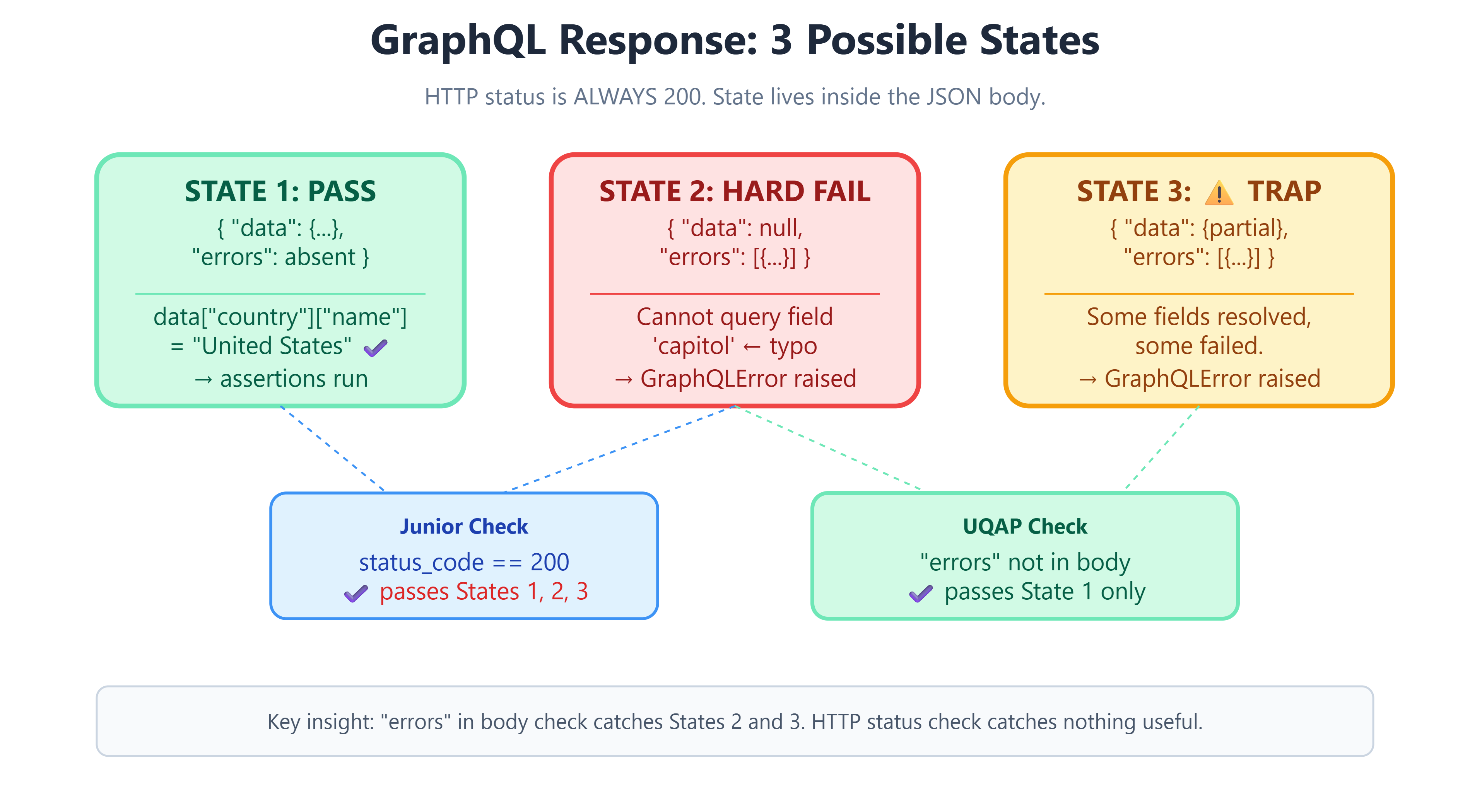
The Failure Mode: HTTP 200 Does Not Mean Success in GraphQL
REST and GraphQL play by completely different rules. In REST, a
404means “not found,” a500means “server error.” The HTTP status code is the result.GraphQL breaks this contract. GraphQL almost always returns HTTP 200, even when your query completely failed. The actual success or failure lives inside the JSON body, in a field called
errors.This is what a failed GraphQL response looks like:
json
{
  "data": null,
  "errors": [
    {
      "message": "Cannot query field 'capitol' on type 'Country'. Did you mean 'capital'?",
      "locations": [{"line": 1, "column": 30}]
    }
  ]
}
HTTP status?
200 OK. Your junior test? ✅ Green. Your CI pipeline? Completely blind to a broken query.There’s also a third, sneakier state:
datais partially populated anderrorsexists simultaneously. GraphQL can return whatever it resolved before hitting an error. Most test frameworks never check for this.