
Lesson 60: Cloud Execution — Running Appium Tests on Real Device Farms

The Junior Trap 🪤
Here’s how most people write their first Appium cloud test. If you’ve done this, don’t worry — we all have:
# THE BAD VERSION — Do not ship this.
from appium import webdriver
import time

desired_caps = {
    "platformName": "Android",
    "deviceName": "Samsung Galaxy S21",
    "app": "my_app.apk",
    "browserstack.user": "myusername",      # 🚨 Hardcoded credential
    "browserstack.key": "myaccesskey123"    # 🚨 Hardcoded secret
}

driver = webdriver.Remote(
    "https://hub-cloud.browserstack.com/wd/hub",
    desired_caps
)

time.sleep(5)  # 🚨 Pray the app loaded
driver.find_element("id", "login_button").click()
time.sleep(3)  # 🚨 Pray the screen transitioned
Let’s count the problems:
Problem
Why It Kills You in CI/CD
Hardcoded credentials Anyone who reads your Git history owns your BrowserStack account
time.sleep(5)You’re paying per second on cloud.
5s × 1000 test runs = 83 minutes of idle billing
No session cleanup
If test crashes, the session stays open.
BrowserStack bills you for it.
Dict for capabilities
One typo → silent failure. No type safety, no IDE help.
No retry logicA 200ms network blip → your test is marked “failed” forever
The Failure Mode
When this runs in a real CI pipeline (GitHub Actions, Jenkins), you’ll see one of these: WebDriverException: Could not start a new session. Response code 401. Message: {”status”:401,”value”:”Unauthorized”} Because the env is different and your hardcoded key was for the wrong account profile.
Or worse — a silent flake. The test “passes” locally, fails on cloud 30% of the time with: NoSuchElementException: An element could not be located Not because your app is broken, but because the cloud device was 800ms slower than your laptop.
These aren’t app bugs. They’re infrastructure bugs — and they destroy team trust in automation.
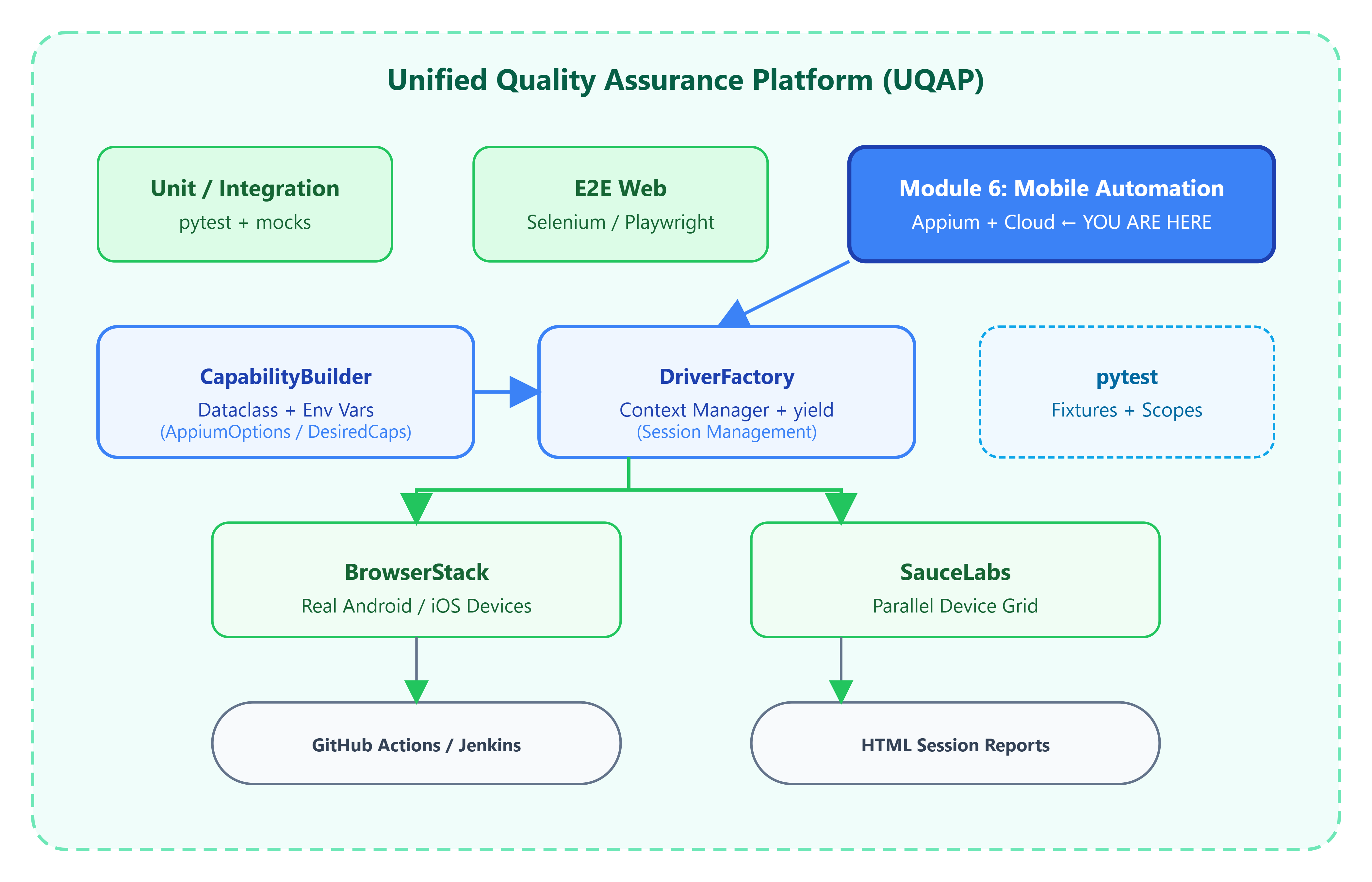
The UQAP Solution: Strategy Pattern + Env-Driven Config
Preparing for a distributed systems interview?
→Download the free Interview Pack
→ Subscribe now to access source code repository - 200 + coding lessons
GitHub Link :
https://github.com/sysdr/auto-testing-manual-p/tree/main/lesson60/lesson60_cloud_executionWe separate three concerns that juniors mash together: [What device/OS] ←→ [Where to run] ←→ [How to interact] CapabilitySet DriverFactory Page Objects
This is the Strategy Pattern. Your test logic never knows if it’s running on a local emulator or a BrowserStack Samsung Galaxy. You swap the strategy; the test stays identical.
Implementation Deep Dive
The CapabilityBuilder Dataclass
@dataclass
class CloudCapabilities:
    platform: str
    device_name: str
    os_version: str
    app_url: str
    build_name: str = "UQAP_CI"
    project: str = "Mobile Suite"
Why a dataclass? Because @dataclass gives you:
Free
__repr__for loggingType enforcement at the field level
Default values without
__init__boilerplate
The critical insight: capabilities are configuration, not code. They should be declarative.
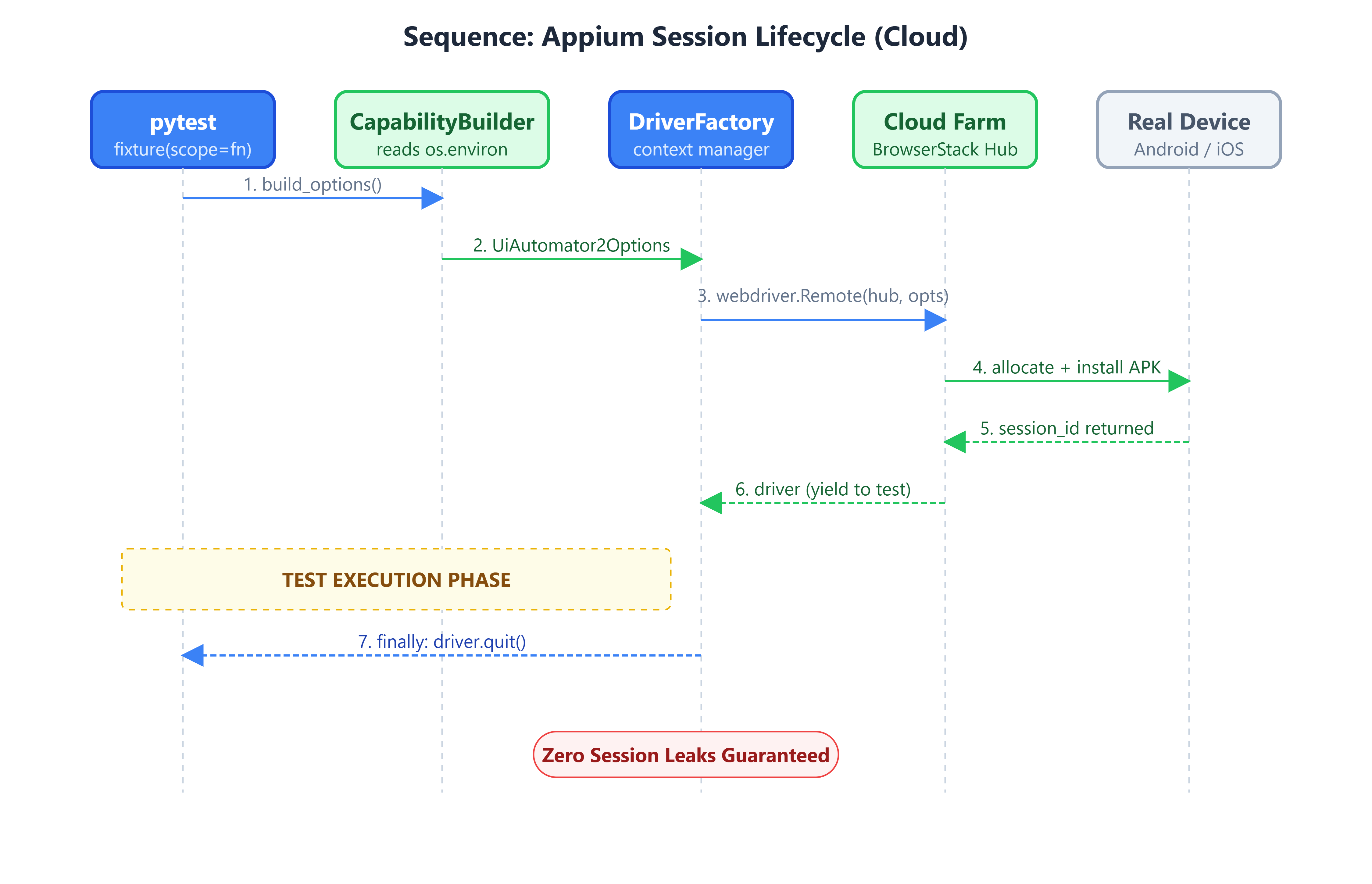
The DriverFactory Context Manager
@contextmanager
def cloud_driver(caps: CloudCapabilities):
    driver = None
    try:
        driver = webdriver.Remote(hub_url, options)
        yield driver          # ← Test runs here
    finally:
        if driver:
            driver.quit()     # ← ALWAYS runs, even on crash
The finally block is your safety net. Whether your test passes, fails, or throws an unhandled exception — driver.quit() fires. No leaked sessions. No surprise billing.
Reading Secrets From Environment
user = os.environ["BS_USERNAME"]    # Raises KeyError if missing
key  = os.environ["BS_ACCESS_KEY"]  # Fail fast > silent wrong value
In CI, these are repository secrets (GitHub Actions) or vault variables (Jenkins). Never in code, never in a .env file that gets committed.
Production Readiness Checklist
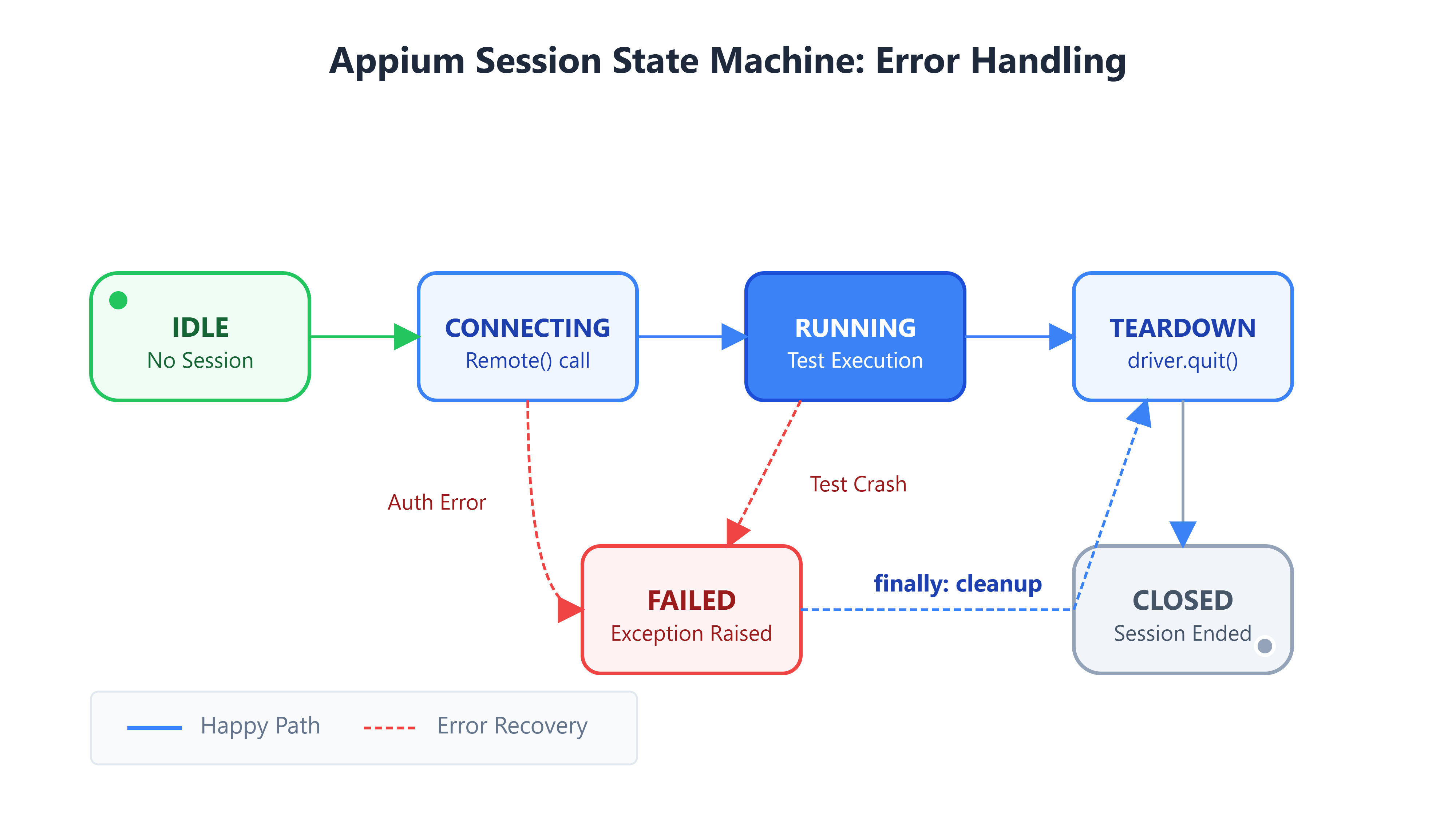
Metric 1 — Session Leak Rate: 0%
Every webdriver.Remote() call must have a corresponding .quit(). Verify in your BrowserStack dashboard: “Completed” sessions should equal test count. Any “Timed Out” sessions = you have a leak.
Metric 2 — Cloud Flake Rate < 2%
Run your suite 10 times. If more than 1 in 50 runs fails for infrastructure reasons (not app bugs), add WebDriverWait with a 15-second timeout. time.sleep() is not an acceptable fix.
Metric 3 — Credential Exposure: Zero Occurrences
Run git log -p | grep -i "access_key\|password\|secret" before every merge. If it finds anything, rotate the key immediately.
Step-by-Step Guide
Prerequisites
pip install appium-python-client python-dotenv pytest
Create a .env file (add to .gitignore immediately): BS_USERNAME=your_browserstack_username BS_ACCESS_KEY=your_browserstack_access_key
Get these from: BrowserStack → Account → Settings → Access Key
(Free trial: 100 minutes on real devices)
Execution
# Run with cloud profile
pytest tests/test_cloud_login.py -v --tb=short

# Run locally against emulator (no cloud needed)
APPIUM_MODE=local pytest tests/test_cloud_login.py -v
Verification
Open BrowserStack App Automate dashboard
You should see your session appear with build name
UQAP_CIVideo recording auto-captures — watch it to confirm element interactions
Session status should be
PASSEDorFAILED(neverERRORorTIMEOUT)
A successful run looks like: tests/test_cloud_login.py::test_app_launch_on_cloud PASSED [100%] Session ID: abc123xyz | Duration: 14s | Device: Samsung Galaxy S21 | Status: ✅