Lesson 86: Slack/Teams Notifications — Build Alerts That Actually Work in Production
Module 9: The Master Capstone | Unified Quality Assurance Platform (UQAP)

The Junior Trap: Why This Seems Easy (and Isn’t)
Imagine your build fails at 2 AM. Nobody knows. The team ships broken code to production. This is the exact problem Slack/Teams notifications solve — but only if you implement them correctly.
Here’s how a junior dev typically writes this:
# DON'T DO THIS
import requests

def test_login():
    result = run_login_flow()
    if not result:
        requests.post(
            "https://hooks.slack.com/services/YOUR/WEBHOOK/HERE",
            json={"text": "Build failed!"}
        )
        assert False, "Login failed"
This looks reasonable. It is a disaster. Here’s why:
Problem 1: Notifications live inside test functions. If your test suite has 200 tests, you’ll get 200 individual Slack messages for a bad run — or zero if the test crashes before reaching that line.
Problem 2: The webhook URL is hardcoded. When your security team rotates that URL (and they will), every test file breaks silently. You’re also one GitHub push away from leaking credentials publicly.
Problem 3: No error handling. If Slack’s API is down, or your CI runner is behind a firewall, requests.post() raises an exception. Your test now fails for the wrong reason — a notification error, not a real test failure. Your failure logs become noise.
Problem 4: You’re using requests. An extra dependency that has to be installed, version-pinned, and managed. In air-gapped environments or minimal Docker images, this fails entirely.
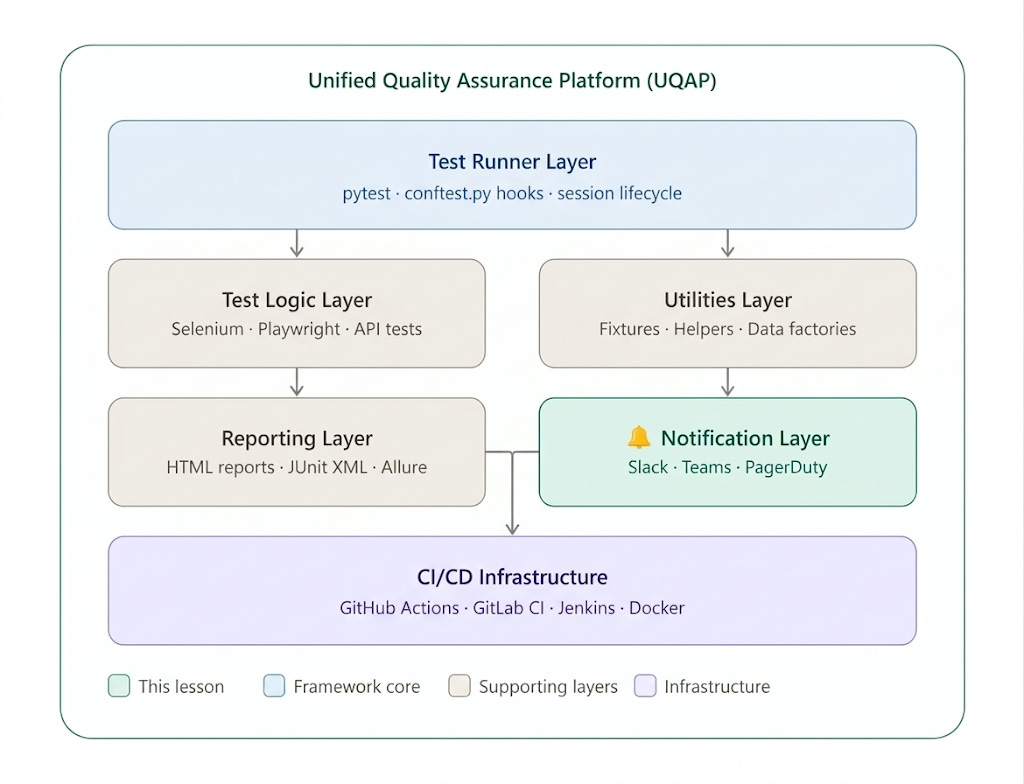
The core misunderstanding: notifications are infrastructure, not test logic. They belong in the test framework layer, not inside individual tests.
The Failure Mode
When you put notification code inside tests, you get what engineers call “noisy failures” — failures where the reported cause is different from the actual cause.
FAILED tests/test_login.py::test_login -
  ConnectionError: HTTPSConnectionPool(host='hooks.slack.com', port=443):
  Max retries exceeded
Your team debugs a connection error for an hour before realizing: the test itself passed, but the Slack notification timed out. This erodes trust in your test suite. When engineers stop trusting alerts, they stop reading them. At that point, your entire notification system is worthless.
The second failure mode is alert fatigue. Granular per-test notifications in a 500-test suite generate so much noise during a bad build that engineers start ignoring them.